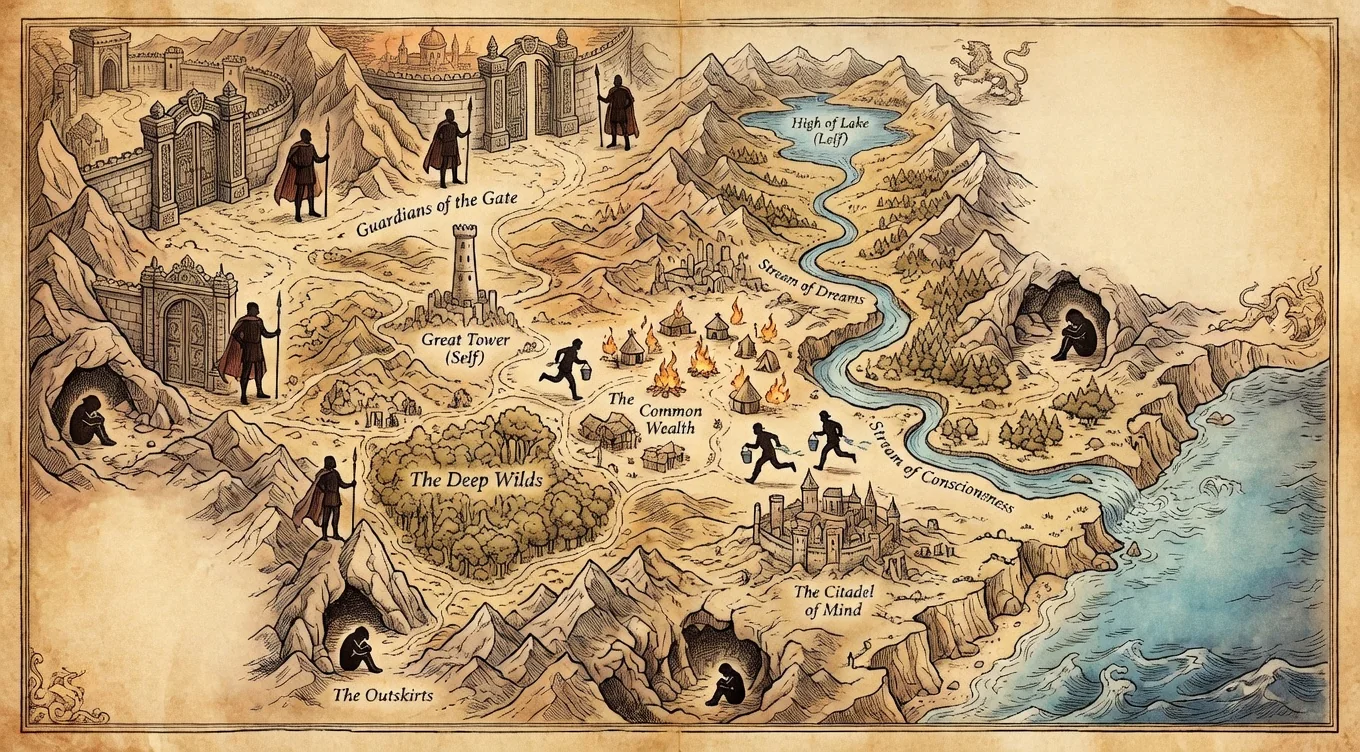
You've read about Internal Family Systems. You know you have Managers, Firefighters, and Exiles. You've sat down to "identify your parts" — and now you're stuck on a question the books never quite answer:
How many am I supposed to find?
Three? Thirty? Is finding only two a sign you're not digging deep enough? Is finding fifteen a sign you're fragmenting every mood into a separate part?
Richard Schwartz, the founder of IFS, gives a deliberately open answer: the mind contains "an indeterminate number of subpersonalities or parts." That's true in theory. In practice, it leaves beginners with no way to calibrate.
This article fills that gap. Based on clinical practice, practitioner session transcripts, and what real parts maps actually look like — including patterns we've seen across thousands of live IFS sessions — here's what you can expect, and a structured method for discovering your parts without over-naming or stopping too soon.
Want to skip the self-mapping and use a structured questionnaire? Take the free IFS parts assessment to get a starting map in 15 minutes.
The clinical norm: 5-8 primary parts per category
Working therapists don't usually try to catalog every sub-part of every mood. They work with a primary cast — the parts that show up often enough, with clear enough roles, to be worth knowing by name.
In clinical practice, a realistic first pass looks like:
- 5-8 Manager parts — proactive protectors such as perfectionism, people-pleasing, planning, control, vigilance
- 3-6 Firefighter parts — reactive soothers and escapers such as numbing, distracting, rage outlets, compulsive behaviors
- 4-8 Exile parts — wounded young parts carrying shame, abandonment, invisibility, or specific memory-linked pain
That's roughly 15-25 primary parts total, with a long tail of minor or situational parts you'll notice once and never formally name.
If you identify fewer than 5 parts total, you're probably still blended — meaning a part is speaking as you, so you can't see it from the outside yet. If you identify more than 30, you're likely fragmenting variations of the same part into separate entities.
Neither is wrong, exactly. Both are signs you're in an early stage. Here's how to move past both.
The three signs you've found a real part
Not everything that feels like a "part" is one. Beginners often mistake moods, body states, and thoughts for parts. A real part has three distinguishing markers.
1. It has an agenda
A part wants something. It has a job. The Inner Critic wants you to not fail. The Pleaser wants you to be liked. The Numb-er wants the pain to stop. Moods don't have agendas — they just happen. If you can't finish the sentence "This part wants…" you're probably dealing with a mood, not a part.
2. It shows up in patterns, not just once
A real part returns. If you felt a flash of dread last Tuesday and never again, that might be a passing state, not a part. If you notice a voice that tells you you'll fail right before big moments — across job interviews, first dates, and performance reviews — that's a part with a consistent role.
3. It has a body signature
Most parts have a physical location. The Critic often lives in the chest or jaw. The Pleaser often sits in the throat or stomach. The Rage often loads the shoulders and back. If you can ask "where do I feel this in my body?" and get a clear answer, you're probably with a part. If the answer is "everywhere" or "nowhere," you may be in a blended state — identified with the part, unable to separate from it.
These are also the signs that distinguish a part from a trailhead — an emotional reaction that leads to a part. A trailhead is the starting point of an inner journey; a part is what you find when you walk down it.
The IFS Companion is a voice-powered self-exploration tool that helps you identify parts as they show up — not from a questionnaire, but from the way you actually talk.
Try the IFS CompanionThe three-category sweep: a structured first-pass method
Most parts discovery guides tell you to "get curious and see what shows up." That's true, but it's like telling a new cook to "just play with flavors." Beginners often benefit from more scaffolding.
Here's a structured protocol you can do in 45-60 minutes. Work through the categories in this order — Managers first, then Firefighters, then Exiles. This order respects IFS's safety principle: you don't bypass protectors to get to the wound.
Phase 1: Map your Managers (15-20 min)
Managers are proactive. They try to keep your life running and prevent pain from emerging. Ask yourself:
- Which parts of me work hard to keep things in order?
- Which voices criticize me, plan for me, push me, or try to make me acceptable to others?
- Which parts monitor other people's reactions?
- Which parts perfectionize, rehearse, or control?
You're looking for 5-8 here. Give each one a working name based on what it does — The Scanner, The Critic, The Pleaser, The Planner. The name doesn't have to be final. Later sessions will refine it.
Phase 2: Map your Firefighters (10-15 min)
Firefighters are reactive. They show up after pain has already surfaced, to put the fire out fast. Ask yourself:
- When I'm overwhelmed, what do I reach for? (Scrolling, eating, drinking, working, rage, shutdown, sex, shopping?)
- What are my "I can't deal with this right now" behaviors?
- Which parts help me escape or numb?
You're looking for 3-6. These are often easier to spot because they produce visible behaviors. Again, name what each one does.
Phase 3: Map your Exiles (15-20 min)
This is the deepest category and requires the most care. Exiles are young, wounded parts carrying the pain your protectors are guarding. Only approach this if you can stay grounded — if you feel flooded, stop and return later.
- What feelings am I chronically afraid of feeling?
- When I imagine myself at 5, at 10, at 15 — who is there? What did they need that they didn't get?
- Which parts of me feel small, broken, unworthy, unseen, or abandoned?
Don't try to visit these parts deeply on a first-pass discovery. You're just noting who's there. Something like "a young part who learned 'I'm too much'" is enough for now. Working with exiles is separate work that requires protector permission first.
You're looking for 4-8. Some exiles will cluster around specific ages or specific memories.
Signs your parts map is bloated
After doing the sweep, some people end up with 30+ parts. That's usually a sign of over-naming — treating every variation as a new entity when they're actually the same part showing up differently.
Watch for these bloat patterns:
Same intention, different labels
If "The Perfectionist," "The High-Standards Manager," and "The Doer-of-Everything-Right" all share the intention of preventing failure through flawless execution, they're probably one part with three names. Merge them.
Same wound, different triggers
If you have "The Rejected Self (at work)," "The Rejected Self (in relationships)," and "The Rejected Self (with family)," those are one exile carrying the same burden across domains — not three separate exiles. Merge them.
Moods treated as parts
If your list includes "The Tired Part," "The Sad Part," "The Frustrated Part," those might be moods showing up in an existing part, not parts themselves. Ask: what part is feeling tired? That's probably your real part — an Overworker or Caretaker Manager.
Ages treated as separate parts
A 9-year-old version of your invisibility wound and a 15-year-old version of your invisibility wound are usually the same exile at two points in time, not two exiles. Unless they have genuinely different roles (e.g., the 9-year-old carries shame, the 15-year-old carries rage), merge them.
Saturation check: when to stop discovering
There's a point where more discovery becomes counterproductive. You stop learning about yourself and start categorizing yourself.
Three signs you've mapped enough for now:
- New parts feel like variations of existing ones. If every new candidate fits inside a part you already named, you've covered the primary cast.
- You can predict your patterns. If you can walk through a typical stressful day and say "the Critic will wake up, then the Pleaser takes over at work, then the Scroller shows up after dinner" — you've mapped enough to see your system in motion.
- Further discovery feels like avoidance. At some point, continuing to map becomes a way to avoid working with what you've already found. The Manager who loves categorizing can easily turn IFS itself into a controlling activity. Notice if that's happening.
When you hit saturation, stop mapping and start relating. The work shifts from "who is in my system?" to "how do I build a relationship with what's here?"
A realistic example
Here's what a cleaned-up parts map looks like in practice — based on real clinical work, simplified for illustration:
Managers (6):
- The Scanner — watches for threats, keeps jaw tight
- The Perfectionist — prevents failure through flawless execution
- The Pleaser — monitors others, abandons own needs
- The Planner — tries to control outcomes by rehearsing
- The Achiever — ties worth to accomplishments
- The Braced Silence — holds back the full story to control how you're seen
Firefighters (3):
- The Numb-er — reaches for food, scrolling, substances when pain rises
- The Rage Outlet — explosive discharge when overwhelmed (screaming, slamming)
- The Deflector — humor and sarcasm to keep interactions surface-level
Exiles (5):
- The Unworthy Child — early wound, "love wasn't enough for me"
- The Invisible One — learned to hide authentic self to stay safe
- The Betrayed One — rage at having given and not received
- The Helpless One — trapped in moments of powerlessness
- The Frightened Child — currently activated, wants to hide from social contact
Total: 14 parts. Distinct roles. Clear relationships — the Pleaser exhausts the system, the Numb-er reacts to the exhaustion, both protect the Unworthy Child. This is a working map — enough to navigate from, not so much that it becomes a taxonomy exercise.
What to do with your map
Having a parts map is not the work itself — it's the starting point. Once you have one, the real work becomes:
- Getting to know your protectors before trying to reach exiles. The 6 Fs framework (Find, Focus, Flesh out, Feel toward, befriend, Fear) is the practical method.
- Working with specific patterns like perfectionism, shame, self-sabotage, or relationship conflict where specific parts cluster together.
- Approaching exiles only with protector permission — the inner child work that goes beyond affirmations.
- Living with your parts as an ongoing relationship, not a one-time mapping exercise.
If you'd rather map your parts in conversation than alone with a worksheet, the IFS Companion helps parts emerge naturally through guided voice or text sessions — and builds an evolving map of your system over time.
Conclusion
Parts discovery is the first step, not the destination. Done well — with realistic expectations, a structured method, and the wisdom to know when to stop — it gives you a map you can actually use.
You don't need to find every part. You need to find the working cast — the 15-25 parts that run your daily life. From there, the real work begins: not more mapping, but relating to what's already been found.
About Our Research
This article draws on Richard Schwartz's foundational IFS framework (Internal Family Systems Therapy, 2nd Ed., Guilford Press; No Bad Parts, Sounds True), practitioner session transcripts from Schwartz, John Clarke, Derek Scott, and Tammy Sollenberger, and clinical norms observed across thousands of live IFS sessions on our platform. The numerical guidelines reflect practical clinical experience — Schwartz himself deliberately avoids prescribing counts, as each system is unique. The norms here are calibration anchors for beginners, not rules.