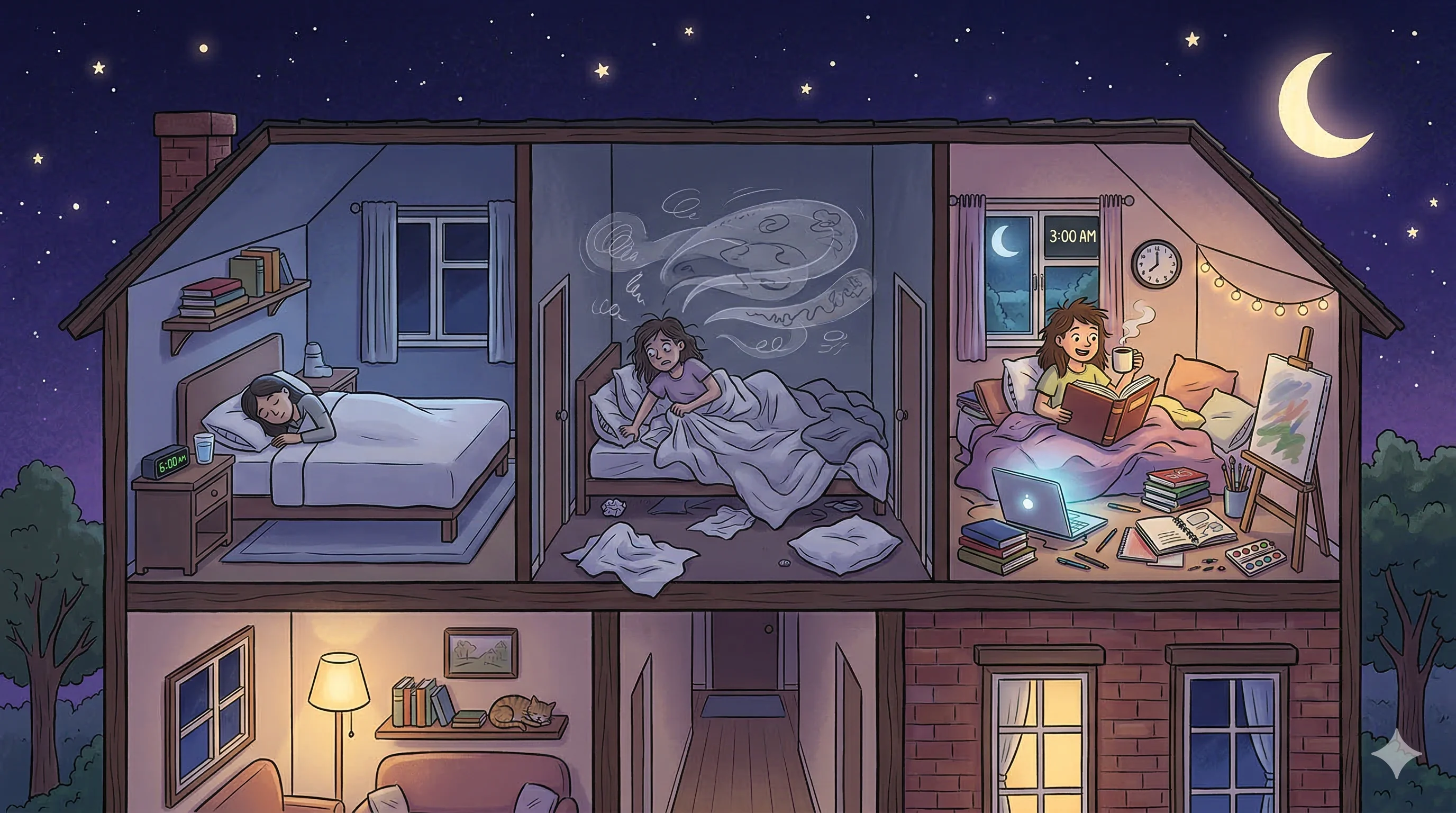
You tuck yourself into bed at a reasonable hour, but instead of drifting off, your mind starts replaying an awkward conversation from three years ago. Or maybe you're the opposite—your head hits the pillow, and you're out like a light, waking up refreshed at 6 AM without an alarm. Why do some of us struggle for hours to catch a few winks while others sleep like champions?
It turns out that your sleep habits aren't just about caffeine intake or screen time—your personality plays a massive, scientifically-proven role. Recent research into the Big Five personality traits reveals that who you are often dictates how you sleep. From the insomnia-prone worrier to the disciplined early riser, your psychological makeup is deeply intertwined with your circadian rhythms.
Understanding this connection is crucial because sleep is the foundation of mental health. When your personality sabotages your sleep, your lack of sleep exacerbates your worst personality traits, creating a self-reinforcing loop that can be hard to break.
The Big Five and Sleep: What the Science Says
Psychologists generally agree on five core dimensions of personality: Openness, Conscientiousness, Extraversion, Agreeableness, and Neuroticism. When researchers map these traits against sleep quality, clear patterns emerge.
Neuroticism: The Primary Enemy of Sleep
If there's one personality trait that consistently ruins rest, it's Neuroticism. Individuals high in neuroticism—characterized by anxiety, worry, and emotional instability—are significantly more likely to suffer from insomnia, poor sleep quality, and daytime fatigue. In fact, neuroticism is often considered the strongest psychological predictor of sleep disorders.
The mechanism is surprisingly straightforward: rumination. High-neuroticism individuals tend to have a "busy brain" at night. They lie awake processing negative emotions, worrying about the future, or dissecting the day's events. This state of cognitive hyperarousal keeps the body's stress response system active, making it physically difficult to transition into deep sleep. It becomes a vicious cycle: poor sleep increases emotional instability, which in turn leads to even worse sleep the next night.
The Cortisol Connection
The link between neuroticism and insomnia isn't just "all in your head"—it's physiological. Neuroticism is linked to a heightened HPA axis reactivity (your body's stress response system). Normally, your cortisol levels should peak in the morning to wake you up and drop to their lowest point at night to allow rest.
However, neurotic individuals often have an inverted or flattened cortisol curve. Due to chronic stress and worry, their cortisol levels remain elevated in the evening. High cortisol signals "alertness" to the brain and actively suppresses the production of melatonin, the hormone needed to initiate sleep. Essentially, their biology is screaming "Danger!" when they are trying to say "Goodnight."
Conscientiousness: The Sleep Master
On the flip side, Conscientiousness is the best predictor of healthy sleep. Highly conscientious people are organized, self-disciplined, and goal-oriented. These traits translate directly into better "sleep hygiene."
Conscientious individuals are more likely to execute the behaviors necessary for good rest without needing constant willpower. They naturally drift towards maintaining a consistent bedtime, avoiding alcohol and caffeine before bed, keeping their bedroom environment optimized, and prioritizing sleep as a "task" to be done well.
Because their lives are generally more organized, they also tend to experience less daily stress, removing one of the biggest barriers to falling asleep. They don't lie awake worrying about unfinished tasks because those tasks are already done or scheduled for tomorrow.
Openness to Experience: The Dreamers
While Openness to Experience doesn't strongly predict sleep quality (duration or depth), it has a fascinating relationship with dreaming. Research consistently shows that individuals high in Openness—who are imaginative, curious, and artistic—report significantly higher dream recall frequency and dream vividness.
This is attributed to "boundary permeability." Open people have thinner psychological boundaries between their conscious and subconscious minds. They are more open to internal experiences, making them more likely to remember their dreams and engage with them upon waking. Their dreams are often more complex, bizarre, and emotionally intense than those of less open individuals.
Chronotypes: Are You an Early Bird or a Night Owl?
Beyond the Big Five, your "chronotype" (your natural sleep-wake preference) is another biological expression of personality. Science confirms that "Early Birds" and "Night Owls" aren't just preferences—they are distinct psychological profiles.
The Early Bird (Larks)
Morning types tend to score higher in Conscientiousness and Agreeableness. They are often proactive, stable, and persistent. "The early bird catches the worm" isn't just a saying; research suggests morning people are often more successful in traditional career paths because their biological clock aligns with the standard 9-to-5 world. They experience less "social jetlag"—the misalignment between biological time and social time.
The Night Owl (Owls)
Evening types present a more complex picture. They tend to score higher in Openness to Experience and often exhibit higher levels of creativity and intelligence. However, they are also more prone to risk-taking behavior and have slightly higher rates of Neuroticism and depression.
A fascinating (and slightly darker) finding is the link to the "Dark Triad" of personality (Narcissism, Machiavellianism, and Psychopathy). Some evolutionary psychologists theorize that eveningness evolved to facilitate "cheater strategies"—behaviors best conducted under the cover of darkness while others sleep. Modern Night Owls aren't villains, of course, but they do tend to be non-conformists who chafe against rigid societal schedules.
The Reverse Loop: How Sleep Deprivation Changes Your Personality
The relationship isn't one-way. Just as your personality affects your sleep, lack of sleep temporarily alters your personality. Several studies have shown that sleep-deprived individuals exhibit changes in their Big Five scores:
- Reduced Conscientiousness: Sleep deprivation impairs the prefrontal cortex—the part of the brain responsible for impulse control and planning. Even the most disciplined person becomes disorganized, impulsive, and prone to procrastination when exhausted.
- Increased Neuroticism: A tired brain is an emotional brain. The amygdala (emotional center) becomes hyper-reactive to negative stimuli when sleep-deprived. Minor annoyances feel like major catastrophes.
- Diminished Extraversion (Social Withdrawal): Interestingly, while Extraverts need social interaction, they are more vulnerable to sleep loss in social contexts. Sleep deprivation makes people less socially adept, less able to read facial cues, and more likely to withdraw from social contact.
This creates a dangerous feedback loop: High Neuroticism causes poor sleep, and poor sleep makes you more neurotic the next day, further damaging your sleep. Breaking this cycle requires conscious intervention.
Actionable Advice: Optimizing Sleep by Personality Type
You can't change your genetics, but you can hack your habits. Here is how to leverage your specific personality profile for better rest.
For the Worrier (High Neuroticism)
The Strategy: "Worry Time" & Cognitive Defusion.
Since your brain wants to problem-solve at night, give it a designated time to do so earlier. Set a timer for 15
minutes at 6:00 PM. Write down every worry. Problem-solve what you can, and accept what you can't. When your
brain starts spinning at 11:00 PM, remind yourself: "I've already handled this." Practicing mindfulness
meditation specifically targeting "defusion" (observing thoughts without engaging with them) is also highly
effective.
For the Chaos Agent (Low Conscientiousness)
The Strategy: Automation & External Constraints.
Don't rely on willpower. Set automated alarms on your phone for "Wind Down" (1 hour before bed) and "Lights
Out." Use smart plugs to automatically dim lights in your house at sunset. Prep your bedroom (closing curtains,
setting thermostat) in the morning when you have energy, so it's ready for you when you're tired and prone to
skipping steps.
For the Night Owl (High Openness/Eveningness)
The Strategy: Light Therapy & Anchoring.
Your internal clock runs slow. You must use light to reset it. Get 15-30 minutes of bright sunlight (or a
lightbox) immediately upon waking—this anchors your circadian rhythm. Conversely, be militant about blue light
at night. Wear blue-light blocking glasses 90 minutes before your intended sleep time to artificially trigger
melatonin production that your body is delaying.
For the Social Butterfly (High Extraversion)
The Strategy: The "Social Detox" Hour.
Social interaction is stimulating and engaging—exactly what you don't need right before bed. While you crave
connection, late-night texting or social media scrolling keeps your brain in a high-alert social mode. Implement
a strictly "asocial" hour before bed: reading, solo meditation, or listening to music without lyrics.
The Bottom Line
Your sleep is a mirror of your mind. By understanding the personality traits that drive your nightly habits, you can stop fighting your nature and start working with it. Whether you need to calm an anxious mind or discipline a chaotic schedule, the path to better rest starts with self-awareness.
Important Note: This article provides educational information about the relationship between personality and sleep based on current scientific research. It is not intended as medical advice. Chronic sleep issues can be a sign of serious medical conditions. If you are struggling with sleep, please consult a healthcare professional or a sleep specialist.