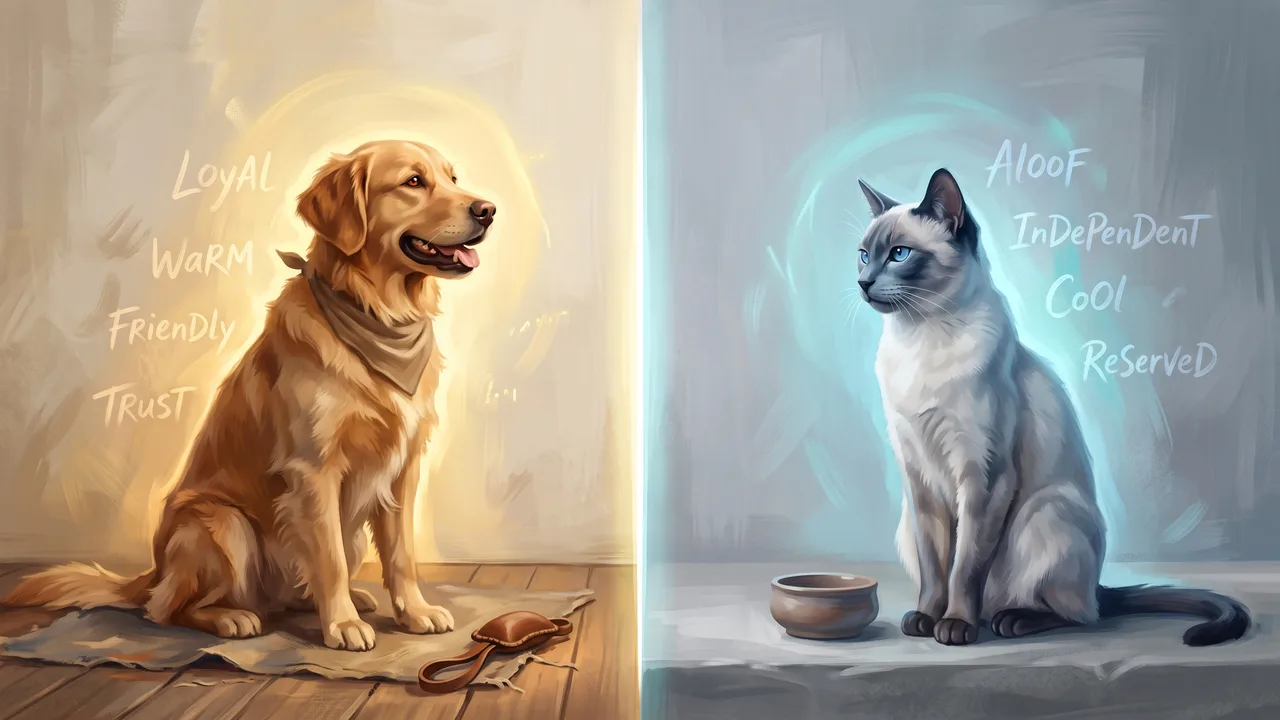
Few questions sort a room faster than "are you a dog person or a cat person?" People answer instantly, and they answer with conviction, as if their choice says something fundamental about who they are. It turns out they might be right. The dog-versus-cat divide is not just a preference. It tracks measurable differences in personality, and the science behind it is more interesting than the stereotypes.
It also runs deeper than the owners. Your pet has a personality too, a real one that researchers can measure with the same rigor used on humans. And the bond between you is shaped by both of your temperaments at once. Here is what the research actually shows about pets, the people who love them, and the relationship in between.
Curious where you land on the traits that predict all this? Take our free Big Five personality test and see your own profile first.
Dog People vs Cat People: The Data Is Real
The definitive study came from Sam Gosling, a personality psychologist at the University of Texas at Austin, and his student Carson Sandy. They surveyed 4,565 people, asked each whether they identified as a dog person, a cat person, both, or neither, and had everyone complete a standard 44-item Big Five assessment.
The differences were clear and consistent. Dog people and cat people are, on average, genuinely different kinds of people:
| Big Five Trait | Who Scores Higher | What It Looks Like |
|---|---|---|
| Extraversion | Dog people (~15% higher) | More sociable, energetic, outward-facing |
| Agreeableness | Dog people (~13% higher) | More warm, cooperative, trusting |
| Conscientiousness | Dog people (~11% higher) | More disciplined, routine-oriented, dependable |
| Openness | Cat people | More curious, unconventional, drawn to art and ideas |
| Neuroticism | Cat people | More emotionally sensitive and reactive |
The pattern fits the animals themselves. Dogs are social, eager, and routine-loving, which appeals to extraverted, agreeable, conscientious people. Cats are independent, curious, and low-maintenance, which suits open-minded people who are comfortable with a less demanding companion. As Gosling put it, the behavioral characteristics of each animal may appeal to people with matching traits.
Two important caveats. First, these are group averages, not destiny. Plenty of disciplined extraverts adore cats, and plenty of dreamy introverts have devoted dogs. Second, the gaps are modest. This is a real signal, not a rigid law. Later research has echoed the broad strokes, with one 2024 study framing it as resilience tending to run higher in dog owners and neuroticism higher in cat owners.
Your Pet Has a Personality Too
For a long time, talking about an animal's "personality" was treated as sentimental projection. That has changed. Researchers now measure animal personality with validated, repeatable instruments, and the results are remarkably structured, echoing the human Big Five rather than contradicting it.
The Feline Five
The landmark cat study, led by Carla Litchfield and colleagues in 2017, surveyed owners of 2,802 pet cats across South Australia and New Zealand, rating them on dozens of traits. The analysis produced five reliable factors, now known as the Feline Five:
- Neuroticism — shyness, anxiety, sensitivity to the environment
- Extraversion — curiosity, activity, inventiveness
- Dominance — bullying or being domineering toward other cats
- Impulsiveness — erratic, reactive behavior
- Agreeableness — affection, friendliness, gentleness
The researchers framed this as a welfare tool, not a party trick. A cat scoring high on neuroticism may be chronically stressed and benefit from more hiding places and fewer social pressures. Knowing where your cat sits on these dimensions lets you shape its environment to fit, rather than expecting one approach to suit every cat.
The Canine Five
Dogs have their own validated five-factor structure, captured by the Monash Canine Personality Questionnaire (MCPQ-R), built using the same adjective-based method that produced the human Big Five. Its five dimensions are:
- Extraversion — the dog's energy level and liveliness
- Motivation — persistence and focus in the face of distractions
- Training Focus — trainability and willingness to work with people
- Amicability — friendliness and tolerance toward humans and other animals
- Neuroticism — nervousness or cautious, fearful behavior
These ratings are consistent across demographics and differ meaningfully across breeds, which is part of why they hold up scientifically. The takeaway is the same for both species: when you say your pet "has a personality," you are not anthropomorphizing. You are describing something measurable.
Your pet has five traits. So do you, and yours shape the whole relationship. See exactly where you fall with precise percentile scores.
Take the Free AssessmentThe Bond: How Your Personality Shapes the Relationship
It is one thing to know that dog and cat people differ. The more useful question is how your personality shapes the relationship you actually have with your animal. A 2024 study by Deborah Wells and Kathryn Treacy, published in Frontiers in Psychiatry, dug into exactly this, and it was the first to factor in the pet's personality alongside the owner's.
Their core finding: the strength of your attachment to your pet is tied to your own traits. Attachment was most strongly linked to neuroticism and conscientiousness. People higher in neuroticism often form especially intense bonds, leaning on the animal for comfort and emotional regulation, while conscientious people invest in the steady, responsible care that deepens a relationship over time.
The study also connected the bond to wellbeing. Lower mental wellbeing in owners was associated with more anxiously attached relationships with their pets, a reminder that the way we relate to animals can mirror the way we relate to people. If your inner world is turbulent, that can show up in how you hold onto your dog or cat.
Wells & Treacy (2024), Frontiers in Psychiatry: The personality traits and mental wellbeing of both owners and pets shape their relationship, making the bond a two-way interplay rather than a product of the owner alone.
Does Matching Personalities Matter?
If both you and your pet have personalities, the obvious question is whether you should match them. The honest answer is that compatibility helps, but it is not a formula.
There is logic to fit. A high-energy, extraverted person may thrive with an equally lively dog, while a calm, introverted person might find an aloof, self-sufficient cat far easier to live with than a dog that needs constant engagement. Mismatches can create friction. An anxious owner paired with a highly neurotic, reactive pet may amplify each other's stress rather than soothe it.
But the research is clear that the bond is not a simple matching exercise. It emerges from the interplay of both temperaments plus the owner's wellbeing, all at once. A great relationship is less about finding your personality twin in animal form and more about understanding both sides well enough to meet in the middle. That starts with knowing your own traits, which connect to far more than your choice of pet, from how you draw energy to how you handle stress.
What This Means If You're Choosing a Pet
If you are weighing a new animal, the science offers a few practical nudges:
- Start with your own traits. Be honest about your extraversion, conscientiousness, and emotional sensitivity. They predict not just dog versus cat, but how much daily engagement you will actually sustain.
- Meet the individual, not the stereotype. Because personality varies sharply within a species and even within a breed, spend time with the specific animal. A mellow dog and a clingy cat both exist.
- Mind the neuroticism match. If you run anxious, a calm, stable animal can be grounding, whereas a highly reactive one may feed the loop.
- Expect a relationship, not a mirror. The best bonds come from understanding the gap between your temperament and your pet's, then managing it with patience.
Before you judge a pet's personality, it helps to understand your own. Get your full Big Five profile with exact percentile scores in about ten minutes.
The Bottom Line
The dog-person versus cat-person divide is not a myth. Dog people tend to be more extraverted, agreeable, and conscientious, while cat people tend to be more open and emotionally sensitive, with the differences real but modest. Your pet, meanwhile, carries a measurable personality of its own, whether that is the Feline Five or the canine five, and the bond between you is built from both temperaments together.
The deeper point is that loving an animal is a relationship between two personalities, not a one-way feeling. Understanding both sides, starting with your own traits, is what turns a pet into the right pet. The stereotypes were never the whole story. The science is far more flattering to both camps, and to the animals that chose to put up with us.
About Our Research
This article synthesizes findings from peer-reviewed personality and animal-behavior research, including Gosling and Sandy's Big Five analysis of dog and cat people, the Feline Five study (Litchfield et al., 2017), the Monash Canine Personality Questionnaire, and Wells and Treacy's 2024 work on pet attachment and owner personality. We base our insights on the scientific record and validated psychological frameworks.