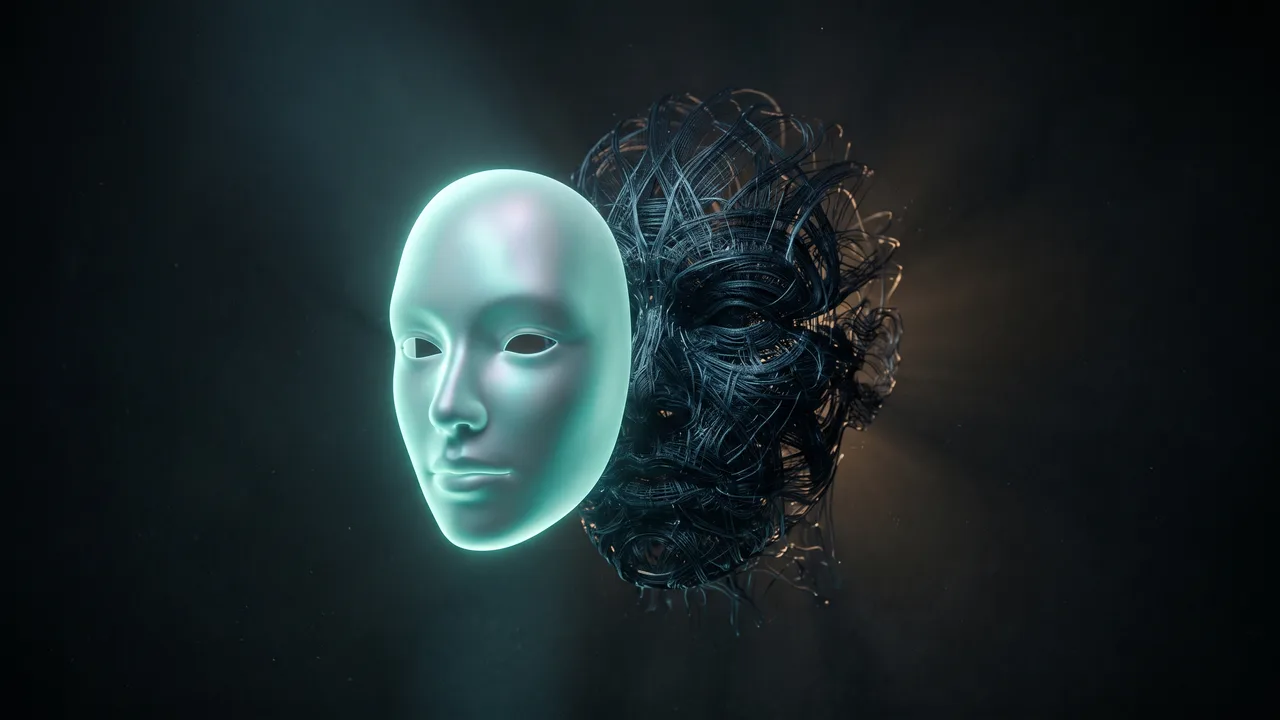
You rehearse the phone call before you make it. You have a set of facial expressions you deploy, and you know which one goes where. You watch how much you are talking. Afterwards, alone in the car, you replay everything you said for an hour, and then you are too tired to cook.
That is masking, and if you have done it for long enough, it stops feeling like a performance and starts feeling like your personality. Which is precisely what makes it so expensive.
What masking actually consists of
Masking, called camouflaging in the research literature, is the effortful work of appearing neurotypical. Researchers generally break it into three kinds of behavior, and most people who mask recognize all three.
- Compensation. Actively substituting learned strategies for intuitive ones: studying how conversation works, copying phrases and expressions from other people or from television, preparing topics in advance.
- Masking proper. Suppressing what would come naturally: not stimming, forcing eye contact you do not want, keeping your face arranged, hiding that the room is too loud.
- Assimilation. Pushing through settings that are genuinely uncomfortable in order to fit in: staying at the event, acting like everything is fine, performing normality even while overloaded.
None of this is dishonesty. It is usually a survival adaptation learned early, often after being punished, mocked, or excluded for behaving naturally. People mask to get jobs, to keep relationships, to be safe, and to avoid the specific exhaustion of being visibly different in public.
The research: it can be measured, and it has a cost
For a long time masking was discussed only inside autistic communities. That changed when researchers built an instrument for it.
Hull et al. (2019), "Development and Validation of the Camouflaging Autistic Traits Questionnaire (CAT-Q)," Journal of Autism and Developmental Disorders: the questionnaire was developed from autistic adults own accounts of camouflaging and administered to 354 autistic and 478 non-autistic adults. The final 25-item measure showed internal consistency of 0.94 and preliminary test-retest reliability of 0.77.
Two things follow from a validated measure. First, camouflaging stopped being an anecdote and became a variable that studies could relate to other outcomes. Second, it confirmed that non-autistic people camouflage too, but autistic adults report doing it far more, and at greater cost.
The cost shows up consistently. Hull and colleagues found camouflaging associated with generalized anxiety and social anxiety in a sample of 305 autistic adults, with a smaller association with depression. Cage and Troxell-Whitman, studying 262 autistic adults, examined why and where people camouflage and found similar links to anxiety and stress, though notably they did not find a difference in depression between groups who camouflaged to different degrees.
Cage & Troxell-Whitman (2019), "Understanding the Reasons, Contexts and Costs of Camouflaging for Autistic Adults," Journal of Autism and Developmental Disorders: 262 autistic adults reported on camouflaging behaviors, the contexts they camouflaged in such as work versus family, and their reasons, such as making friends or avoiding negative treatment.
That study makes an important point often lost in the discussion: people do not mask for no reason. They mask for conventional, defensible reasons, in specific contexts, and usually because the alternative has gone badly before.
The costs that do not show up on a scale
Beyond anxiety, three consequences come up repeatedly in autistic adults accounts.
It is a direct route to burnout
Masking runs continuously and consumes capacity that is then unavailable for everything else. Sustained past what a person can afford, it is one of the most commonly named contributors to autistic burnout, a state of exhaustion and skill loss that is regularly mistaken for depression.
It delays identification by decades
The better you mask, the less likely anyone is to see anything to assess. This is a large part of why women and people identified late are disproportionately missed: they present as anxious, or shy, or intense, or simply as coping, and the underlying pattern is never examined. Clinicians unfamiliar with high-masking presentations often conclude, sincerely, that the person in front of them cannot be autistic because they made eye contact and held a conversation.
It blurs your own self-knowledge
This is the cost people describe with the most feeling. After enough years, the question "what do I actually want, and what am I actually feeling" becomes genuinely hard to answer, because so much of your behavior has been calibrated to other people. Some describe not knowing which preferences are theirs and which are performances.
If masking is unavoidable in some parts of your life, the practical move is to budget the recovery alongside it rather than treating downtime as something you earn afterwards. Our toolkit has specific strategies for energy and masking recovery.
See the energy strategiesWhat unmasking honestly involves
The popular version of unmasking is a dramatic reveal. The realistic version is quieter and more strategic.
It is not all or nothing. Nobody unmasks everywhere. The goal is deliberate choice: knowing when you are doing it, deciding where it genuinely serves you, and not paying the cost automatically in places where nothing requires it.
Safety is a real variable. Unmasking has social and professional consequences that fall unevenly, and they are heavier for people who are already marginalized. Advising anyone to simply stop masking at work ignores who can afford that and who cannot. Start where it is safe.
Start with one context. One person, one room, one hour. For many people the first unmasked context is being alone deliberately rather than collapsing alone, which is a different thing.
Expect it to feel wrong before it feels good. Dropping a lifelong compensation strategy sets off alarms that are not accurate readings of danger. Feeling exposed is not evidence that unmasking was a mistake.
Common questions
Do only autistic people mask?
No. The CAT-Q validation work found non-autistic adults camouflage too. What differs is the frequency, the effort involved, and the accumulated cost.
Can you mask without knowing it?
Very commonly. People who have masked since childhood often describe it as automatic and only recognize it in hindsight, frequently after reading a description like this one.
Does masking mean my traits are mild?
No, and this is a persistent misunderstanding. Masking hides traits from observers, it does not reduce them. A person who masks heavily may be carrying more load, not less, since the masking itself is additional work.
If I have masked my whole life, how do I know what my real traits are?
Start from the inside rather than the outside: what drains you, what restores you, what you do when nobody is watching, what you would stop doing tomorrow if there were no consequences. That is the angle the TraitPath profile is built on.
A note on what this is: this article is educational, not diagnostic. Nothing here can tell you whether you are autistic, ADHD, or anything else. Only a qualified clinician can assess that, and if these patterns fit you closely, here is how adult assessment actually works. This is not therapy or medical advice.