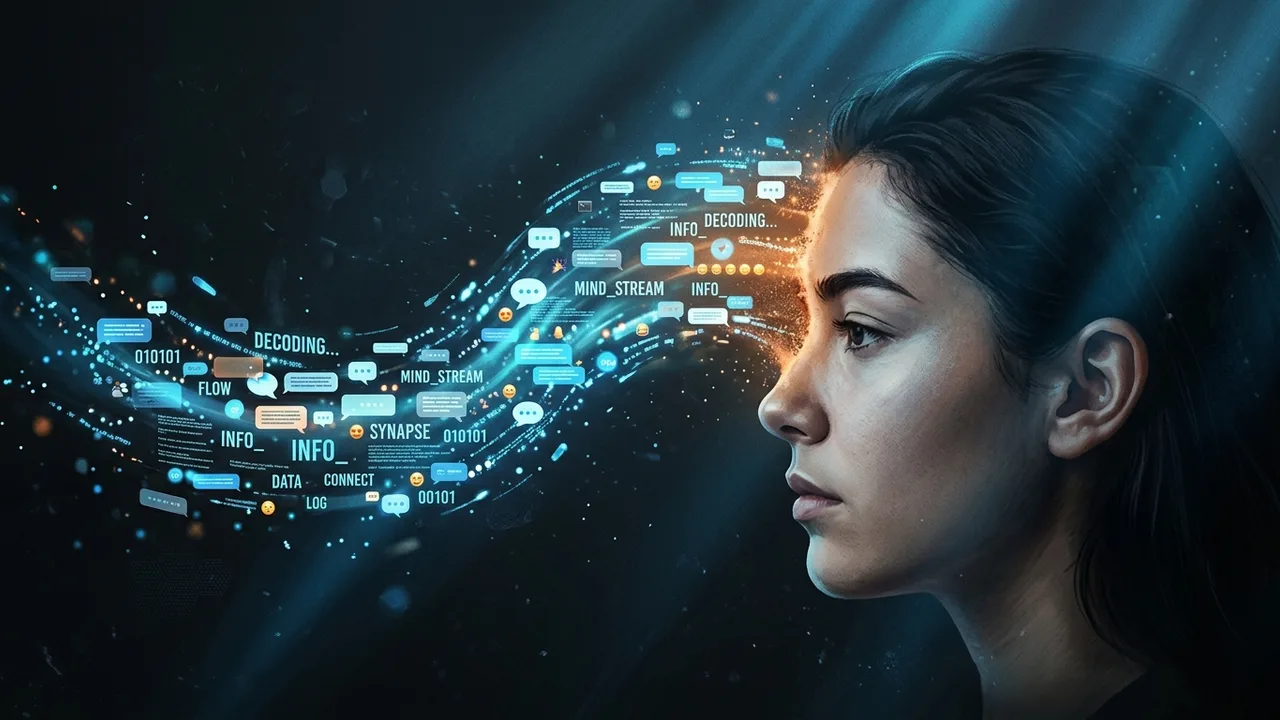
We usually ask what an AI knows about the world. The more uncomfortable question is what it knows about you. Every time you type a message into a chatbot, you are not just asking for an answer. You are leaving behind a trail of word choices, sentence rhythms, topics, and tics that, it turns out, say a surprising amount about who you are.
In 2026 a team of researchers put that idea to the test directly. They collected real ChatGPT histories from hundreds of volunteers, trained an AI to guess each person's personality, and then checked the guesses against actual personality tests. The result lands somewhere between fascinating and unsettling: your chatbot conversations are a readable psychological signal, and the more you talk, the louder it gets.
Curious how your own traits would score on a proper assessment instead of a guess? Take our free Big Five personality test and see your real profile.
The Study: An AI Trained to Read You
The research came out of ETH Zurich, with a team led by Noé Zufferey and a paper authored by Derya Cögendez and colleagues, posted to the arXiv preprint server in 2026. The setup was refreshingly concrete. Rather than theorize about whether language leaks personality, they went and got the language.
The researchers recruited 668 ChatGPT users in the United States and the United Kingdom and asked them to share copies of their actual chat histories. That added up to roughly 62,000 conversations. They sorted those chats by topic, then trained an AI model to estimate the likelihood that each user scored high or low on the five traits psychologists call the Big Five: openness, conscientiousness, extraversion, agreeableness, and emotional stability (the calm end of neuroticism).
Crucially, they had ground truth to grade against. The volunteers had also completed validated personality questionnaires, so the team could compare the AI's guess to a real score, person by person.
How Accurate Was It?
The headline finding: the fine-tuned model could infer a user's personality traits with up to roughly 60% accuracy. That is well above random chance, and it was achieved from chat logs alone, without any test, survey, or direct question about personality. The model was effectively eavesdropping on how people write and inferring the person behind the prose.
But the accuracy was not evenly spread across the five traits. The model read some dimensions much more reliably than others:
- Easiest to read: extraversion and emotional stability. These traits broadcast themselves in language. An extravert's energy, social references, and exclamation-heavy enthusiasm are hard to hide on the page.
- Hardest to read: conscientiousness. Being organized and dependable does not leave an obvious verbal signature in a casual chat, so the model kept missing it.
There was also a topic effect that should give anyone pause. The subjects you raise change how much you give away. The researchers noted, for example, that people who discussed religion with the AI made their conscientiousness level easier to infer. In other words, certain conversations are more revealing than others, often the ones you would least expect.
Lead researcher Noé Zufferey (ETH Zurich, 2026): "AI agents could be leveraged for mass surveillance and massive propaganda campaigns that would make extensive use of personalized user-AI interaction."
How Does Text Reveal Personality at All?
This is not magic, and it did not start with chatbots. Decades of psycholinguistic research have shown that personality traits leave consistent fingerprints in how people use language. Long before large language models, researchers were counting pronouns, emotion words, and sentence structures to predict the Big Five.
The patterns are intuitive once you see them:
- Extraversion shows up as social, energetic, positive language, more references to people, parties, and activity, and a faster, more exclamatory rhythm.
- Openness appears in abstract, exploratory vocabulary, unusual word choices, and a willingness to wander into ideas, metaphors, and tangents.
- Agreeableness reads as warm, cooperative, polite phrasing, hedges that soften disagreement, and more gratitude and inclusive "we" language.
- Neuroticism tends to surface through negative emotion words, self-focused "I" language, and anxious or absolute framing.
- Conscientiousness is the quiet one, sometimes hinted at by orderly, planning-oriented language, but easy to mask in everyday chat. This is exactly why the AI struggled with it.
What modern AI adds is scale and subtlety. Instead of a researcher hand-counting a few categories, a language model can pick up on thousands of faint statistical cues at once, across tens of thousands of messages, and combine them into a probabilistic read. It is the same idea earlier research pioneered, turned up to an industrial volume.
An AI scraping your chat logs produces an estimate. Our assessment measures your Big Five traits directly, with precise percentile scores against large normative samples.
Take the Free AssessmentThe Mirror Image of AI Personality
If this sounds familiar, it should. In a companion piece on AI language model personalities, the finding was that models like Claude, ChatGPT, Gemini, and Grok express measurable personality traits of their own. This study is the mirror image. There, the machine has a personality. Here, the machine reads yours.
Put the two together and you get the real shape of modern human-AI conversation: two personalities in the room, one of them silently profiling the other. Every exchange is a small two-way personality assessment, except only one side has been told the test is happening.
Why This Matters: The Risk Is at Scale
For any one person, a 60%-accurate guess about your traits is not catastrophic. It is the kind of thing a perceptive friend could manage after reading your messages. The concern the researchers raised is not about the individual. It is about what happens when this runs automatically across millions of people.
Three implications stand out:
1. Personalized persuasion. Personality data is the fuel of targeted influence. Knowing whether someone is anxious, agreeable, or novelty-seeking lets a message be tuned to land. The same study warns this could power large-scale propaganda and disinformation tailored to each reader's psychology.
2. The more you chat, the more you reveal. The model got better at inferring personality the longer a person's chat history was. As AI assistants become daily companions with persistent memory, the profile they could build only sharpens over time. This connects to a broader pattern in AI design, where systems grow more tailored, and more influential, the more they learn about you.
3. You did not consent to a personality test. No one in the study sat down to be assessed. The profiling happened in the background, from ordinary conversation. That gap between what you think you are doing (asking for a recipe) and what is inferable (your emotional stability) is the heart of the ethical problem.
An Inferred Profile Is Not a Real One
Here is the part worth holding onto. The fact that an AI can guess your personality at 60% accuracy is genuinely impressive, and it is also a reminder of how different a guess is from a measurement.
An AI reading your chat logs is working backward from indirect, noisy signals, and it has no way to verify whether its read is right. It cannot tell the difference between your everyday self and the version of you that is stressed, joking, or roleplaying. It confuses the topic you happened to discuss with the trait you actually hold. And it quietly misses whole dimensions, conscientiousness being the obvious one, because they do not announce themselves in casual text.
A validated assessment works the opposite way. It asks calibrated questions that were tested across large populations precisely to isolate each trait, then scores you against normative data so the result means something. The difference is the difference between someone guessing your height from a photo and someone handing you a tape measure.
If an algorithm can sketch your personality from the side, it is worth knowing the real thing for yourself. Get your full Big Five profile with exact percentile scores in about ten minutes.
The Bottom Line
Yes, AI can predict your personality from your chat history, with meaningful but imperfect accuracy, and it does so by reading the same linguistic fingerprints psychologists have studied for decades. It is best at the traits you wear on your sleeve and worst at the quiet, internal ones. The individual risk is small, but the at-scale risk, mass profiling and personalized persuasion, is real and worth taking seriously.
The deeper takeaway is about awareness. Your words carry more of you than you intend, and increasingly there are systems built to listen for it. Understanding that you are legible is the first step to deciding how much you want to reveal, and to whom. And if you are going to be measured, it is better to do it deliberately, with a real assessment, than to be quietly estimated by a machine you were only asking for the weather.
About Our Research
This article synthesizes findings from peer-reviewed and preprint personality research, including the 2026 ETH Zurich study on inferring personality from ChatGPT histories, alongside established psycholinguistic literature on the Big Five. We base our insights on the scientific record and validated psychological frameworks.