According to a 2025 survey by Resume.org, 42% of Gen Z have already used AI tools like ChatGPT for career decisions — the highest of any generation. Nearly half say they trust ChatGPT more than their own manager for work questions.
People aren't doing this because it's trendy. They're doing it because career coaching has been gatekept behind $200/hour price tags, and a decent AI conversation at 2 AM beats no guidance at all.
But if you've tried asking ChatGPT to help you navigate a career transition, negotiate a raise, or figure out whether to take a job offer — you've probably noticed something: the advice feels like it could be for anyone. That's because it is.
The Problem: ChatGPT Doesn't Know Who You Are
Here's what happens when you ask ChatGPT a career question. You type something like: "I'm thinking about switching from marketing to product management. Should I?"
ChatGPT will respond with a reasonable, well-organized, entirely generic answer. It'll list transferable skills. It'll suggest networking. It might recommend a certification. It's the career equivalent of a WebMD diagnosis — technically not wrong, but not particularly useful either.
The problem isn't intelligence. ChatGPT is brilliant. The problem is context. It doesn't know:
- Whether you're an introvert who thrives in deep-focus work or an extravert who energizes through collaboration
- That you tried switching careers two years ago and a fear of failure stopped you
- That your real frustration isn't the role — it's a toxic boss
- What you told it last week about your goals, because it doesn't remember
Want career guidance that actually knows who you are? Try our AI Career Coach — it uses your personality profile and remembers your goals across sessions.
A good career coach doesn't just give information. They understand you — your personality, your patterns, your fears, your history — and then help you make decisions through that lens. Generic AI skips all of that.
Five Things a Specialized Career Coach Does That ChatGPT Can't
1. It Knows Your Personality
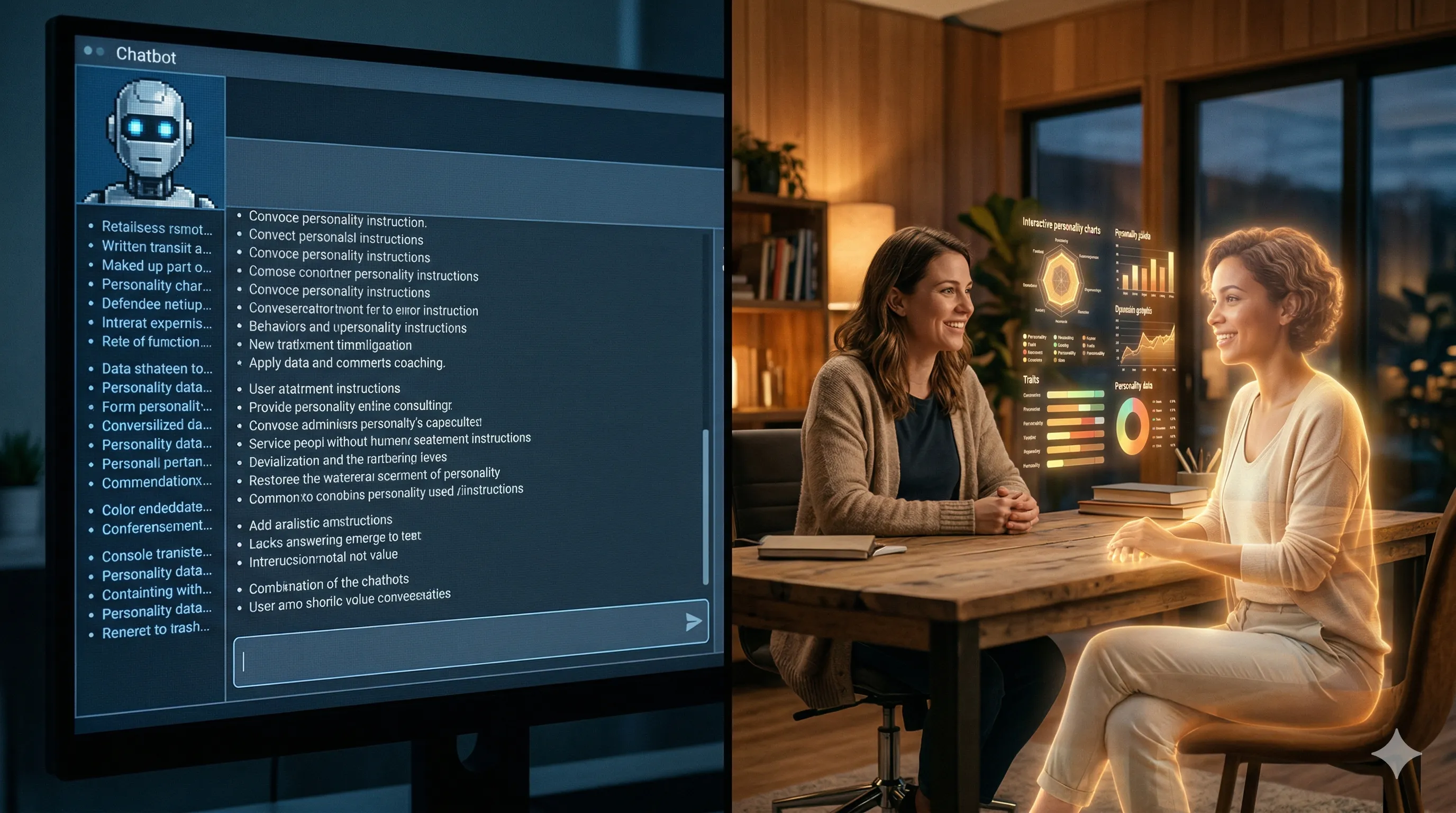
ChatGPT gives the same advice to a highly agreeable, conflict-averse introvert as it does to an assertive, competitive extravert. A specialized AI career coach integrates your actual personality data — your Big Five scores, your MBTI type, your Enneagram — and uses it to shape every piece of guidance.
This isn't a gimmick. Research in personality psychology consistently shows that personality-based coaching produces fundamentally different, more actionable advice than generic guidance. An introvert doesn't need tips on "networking at events" — they need strategies that work with their wiring, not against it.
2. It Remembers Your Story
Every conversation with ChatGPT starts from zero. You re-explain your situation every time. You repeat your goals, your blockers, your history. It's like going to a different career counselor every single session.
A purpose-built career coach maintains a persistent coaching relationship. It remembers that last week you committed to updating your resume by Friday. It tracks your goals, your skills-in-progress, your blockers, and your action items. When you come back, it picks up where you left off — just like a real coach would.
3. It Uses Real Coaching Frameworks
Professional career coaches don't just freestyle conversations. They use validated frameworks — the GROW model for structuring decisions, Schein's Career Anchors for understanding deep motivators, Ikigai for finding direction.
ChatGPT knows about these frameworks if you ask. But it doesn't use them. It won't guide you through a structured Goal → Reality → Options → Will conversation. It won't recognize when you're confusing a surface-level frustration with a deeper motivational mismatch. A specialized coach does this automatically, weaving frameworks into the conversation without lecturing about them.
4. It Handles Real Workplace Problems
Career guidance isn't just about choosing a career path. Most of the time, people need help with the messy, human stuff: a difficult boss, a raise negotiation, a confusing job offer, workplace politics, imposter syndrome hitting right before a big presentation.
ChatGPT can give you a generic script for asking for a raise. A specialized career coach will factor in your personality (are you conflict-averse? do you tend to undersell yourself?), your context (how long you've been in the role, what leverage you have), and pressure-test your plan before you walk into that meeting.
According to the Conference Board (2026), AI can deliver up to 90% of day-to-day coaching functions — but only when it's structured, contextual, and embedded in an ongoing relationship. A one-off ChatGPT conversation doesn't qualify.
5. It Creates Accountability
Here's the uncomfortable truth about career advice: most people don't act on it. They get inspired, they make a plan, and then life happens and the plan collects dust.
Research from Gitnux suggests that structured AI coaching accelerates skill development 2.7x faster than self-study — but only when it provides consistent follow-up and accountability. A specialized coach checks in on your commitments. It asks: "Last time you said you'd reach out to three product managers this week. How did that go?" That one question is worth more than a hundred bullet-pointed tips.
The Workplace Dynamics Gap
One of the biggest blind spots in how people use ChatGPT for career help is that they only ask it about career direction — "What job should I do next?" — when most of their actual pain is about what's happening at work right now.
A good career coach also helps with:
- Managing up: How to communicate with a micromanaging boss, how to get visibility for your work, how to manage expectations
- Negotiation: Salary conversations, promotion cases, counter-offers, knowing your worth
- Contracts and offers: What to look for in compensation packages, red flags in non-competes, questions to ask before signing (not legal advice — but practical coaching on what to negotiate)
- Conflict: A colleague taking credit for your work, being passed over for a promotion, navigating a toxic team without burning bridges
- Self-advocacy: Speaking up in meetings when a part of you is terrified of looking stupid, setting boundaries with a boss who expects 24/7 availability, handling imposter syndrome in real-time
ChatGPT can tell you about negotiation tactics. A career coach walks you through your specific negotiation, with your personality, in your context.
When ChatGPT Is Actually Fine
To be fair — ChatGPT is great for certain career tasks. If you need help formatting a resume, drafting a cover letter, preparing for common interview questions, or researching a company, it's a fantastic tool. These are information tasks, and ChatGPT excels at information.
Where it falls short is in the coaching tasks — the ones that require knowing you, challenging your assumptions, understanding your patterns, and pushing you past the comfortable into the actionable. That's where specialization matters.
78% of people who use structured AI coaching report improved confidence in their professional capabilities, and manager effectiveness scores improve 41% after participation in AI coaching programs (Gitnux AI Coaching Statistics). The key word is structured — not one-off conversations with a general-purpose chatbot.
What to Look For in an AI Career Coach
Not all "AI career coaches" are created equal. Some are just ChatGPT with a career-themed wrapper. Here's what actually matters:
- Personality integration: Does it know your traits and adjust its guidance accordingly?
- Persistent memory: Does it remember your goals, blockers, and progress across sessions?
- Coaching frameworks: Does it use validated coaching models, or just give freeform advice?
- Workplace scope: Can it help with negotiations, conflict, and workplace dynamics — not just "what career should I pick?"
- Accountability: Does it track commitments and follow up on action items?
- Honest challenge: Does it pressure-test your plans, or just validate everything you say?
If the answer to most of these is "no," you're just using ChatGPT with a costume on.
The Bottom Line
ChatGPT democratized access to information. That matters. But career coaching isn't about information — it's about applying the right information to your specific situation, personality, and goals. A generic AI gives generic advice. A specialized career coach gives you a mirror, a map, and a push.
The same way you wouldn't ask a general-purpose calculator to do your taxes when TurboTax exists, you shouldn't ask a general-purpose chatbot to coach your career when purpose-built tools exist.
The question isn't whether AI can help with your career. It absolutely can. The question is which AI — and whether it actually knows who you're talking to.
Sources & Research
This article draws on research from the Conference Board, Gitnux AI Coaching Statistics, Resume.org surveys, and personality psychology literature on coaching effectiveness. All statistics are cited inline with links to original sources.